James Gordon
Batman the Dark Knight Returns 10th Anniversary Edition HardcoverJames Gordon is the veteran commissioner of the Gotham City Police Department and one of the essential human counterweights to Bruce Wayne / Batman. His significance lies not in matching Batman’s physical force, but in preserving a civic and moral continuity that outlasts retirement, institutional decay, and catastrophe. Through James Gordon, the story remembers what Batman’s war once meant to the city: not merely fear imposed on criminals, but an alliance between extraordinary intervention and public responsibility.
Identity and the Old Alliance
James Gordon belongs to the older order of Gotham City, a police leader whose authority is grounded in service rather than spectacle. The narrative places him beside the aging Bruce Wayne / Batman as a figure shaped by the same decades of crime and compromise, but still attached to the institutions that Batman abandoned. His connection with Batman is therefore both professional and personal: James Gordon understands the necessity of Batman’s mission even when the law cannot openly authorize it, while Batman’s return gains historical and emotional weight because James Gordon remains one of the people who remembers the earlier partnership.
The contrast between them becomes sharper as both men age. Bruce Wayne / Batman experiences retirement as an intolerable loss of identity and purpose, whereas James Gordon has moved toward the limits imposed by age and public office. Yet James Gordon’s retirement does not erase his commitment to Gotham City. His continued presence turns the past into a living standard against which the city’s diminished police force, political responses, and successive emergencies can be judged.
Witness to Batman’s Return
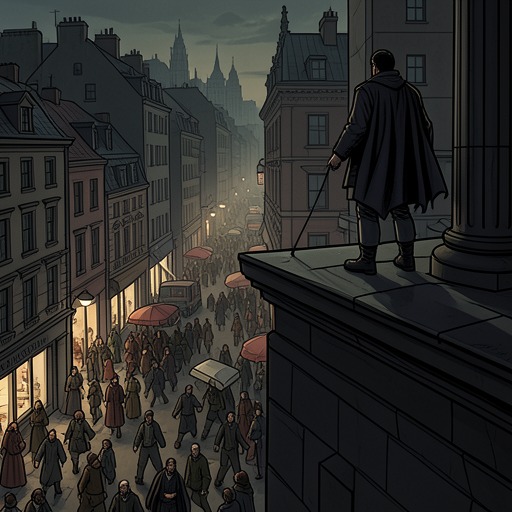
When Bruce Wayne / Batman resumes his campaign, James Gordon is not simply a bystander to a legendary figure’s reappearance. He is one of the narrative’s principal witnesses to the return, and his perspective helps establish that the crisis is larger than an old man’s private obsession. Gotham City’s social decay, the rise of the Mutant Gang, and the failure of ordinary authority create conditions in which the old alliance becomes newly relevant.
James Gordon’s role connects Batman’s personal decision to the city’s public emergency. Batman confronts the Mutant Gang while the police struggle to contain a threat that has grown beyond conventional control, and James Gordon’s long experience makes the meaning of that confrontation legible. The conflict is not presented as a clean restoration of the past: Batman is older, the city is more unstable, and the methods required to recover order are increasingly extreme. James Gordon’s presence keeps that tension visible, because he represents the law even when the law is unable to act effectively.
Retirement, Crisis, and Public Order
James Gordon’s retirement marks a decisive change in the relationship between Batman and the Gotham City Police Department. His departure removes a crucial intermediary who had once allowed Batman’s illegal work to coexist with a principled public authority. The resulting vacuum contributes to the sense that Gotham City has lost not only a protector but also a shared language for distinguishing justice from uncontrolled violence.
That vacuum becomes especially important during the city’s wider emergencies. The Gotham City blackout and the breakdown of public order expose the weakness of institutions that have relied on routine rather than courage. Batman responds by organizing citizens and directing them toward restoring order, while James Gordon’s legacy remains present in the civic ideal that such action is meant to serve. The later emergence of the Sons of Batman shows how easily Batman’s symbolism can be detached from the restraint associated with James Gordon’s generation: collective action can restore security, but it can also become another form of coercive rule.
James Gordon’s significance in these episodes is therefore partly retrospective. He embodies a model in which force is answerable to a public purpose, even though that model is never free from contradiction. His career does not prevent Gotham City’s collapse, but it supplies the moral memory against which the city’s new forms of emergency power are measured.
The Final Phase of His Life
In the final movement of the story, James Gordon’s age becomes more than background detail. His presence alongside the declining generation of established figures emphasizes the bodily and historical costs of the struggle. Batman’s actions grow more dangerous as he faces increasingly powerful opponents, while James Gordon represents the ordinary human limit that Batman continually refuses to accept.
The return of Batman to public life also changes James Gordon’s position from active institutional partner to elder witness. He sees the consequences of Batman’s renewed war, the public upheavals that follow, and the confrontation between Bruce Wayne / Batman and Clark Kent / Superman. That conflict brings the story’s old questions about authority, law, and necessity into direct collision, and James Gordon’s long relationship with Batman gives those questions a human scale. Batman’s methods may become harsher, but James Gordon’s history with him prevents the character from being reduced to either a criminal or a symbol.
By the ending, James Gordon’s generation is giving way. Batman stages his death rather than accepting the finality imposed by the state and the public narrative, then prepares a hidden continuation of his mission. The implication is not that James Gordon’s work has become irrelevant, but that its values must be transmitted after the institutions that once carried them have weakened. James Gordon’s life thus forms part of the bridge between Batman’s first era and the future shaped by younger followers.
Narrative Role and Significance
James Gordon functions as the story’s human measure of continuity. Bruce Wayne / Batman repeatedly turns toward myth, disguise, and physical confrontation; James Gordon remains tied to memory, civic office, and the visible consequences of violence. His presence prevents the narrative from treating Batman’s return as a purely private resurrection. The return matters because it reopens an old relationship between a masked vigilante and a public servant, and because Gotham City still needs the kind of moral structure that relationship once represented.
His arc also clarifies the story’s treatment of aging. James Gordon does not defeat age by denying it. Instead, his retirement and later witness position show how a person can relinquish direct power without surrendering judgment or responsibility. Against Batman’s refusal to stop, James Gordon offers a different form of endurance: remaining faithful to the meaning of the work even when the body, office, and historical moment have changed.
For that reason, James Gordon is not merely an ally who supports Batman’s plot. He is the custodian of its ethical memory. His relationship with Batman carries the past into the crises of the present, while his departure from active command makes clear what is lost when trust between law and conscience disappears. The future implied by Batman’s staged death may belong to younger recruits, but it inherits its legitimacy from the standards James Gordon spent his life defending.